NASA’s Curiosity rover executed a daring “sky crane” landing on the floor of Gale Crater. Fourteen years later, almost to the day, this veteran explorer has proven that Mars still holds the power to stun the scientists who guide it. While ascending Valle Grande, a valley carved into the lower foothills of the massive Mount Sharp, Curiosity transmitted a breathtaking robotic view that disrupted the mission’s routine.
Instead of the chaotic, random distribution of red dust and broken stone, the rover’s mast cameras captured a meticulously organized geometric carpet. This wasn’t just a small patch of interesting geology; it was a vast, rhythmic expanse of honeycomb-like textures. As we mark nearly a decade and a half of exploration, this discovery serves as a reminder that we are still just beginning to read the complex biography of the Red Planet.
Takeaway 1: The Unprecedented Scale of the “Sea of Polygons”
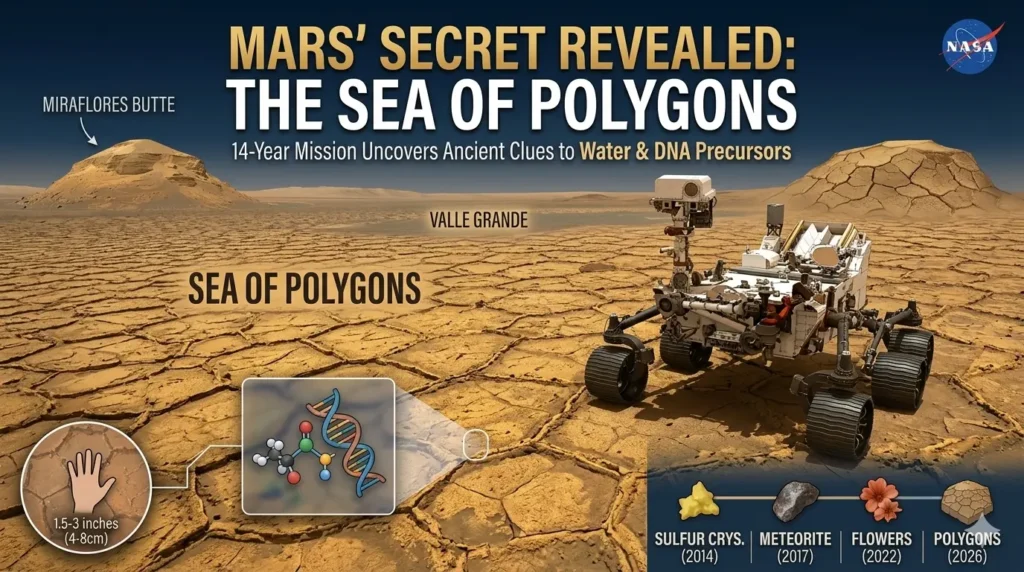
What makes the discovery in Valle Grande a standout moment in the mission’s history is its staggering scale. While Curiosity has encountered individual polygonal fractures before, it has never seen a field that dominates the landscape so completely. These geometric shapes, measuring between 1.5 to 3 inches (4 to 8 centimeters) across, form a repeating pattern that stretches to the horizon.
Captured in a 360-degree panorama on June 19 and 20, 2026—recorded as Sols 4,930 and 4,931 of the mission—the textures appear as an endless sea. The shapes are so pervasive that they even climb the vertical faces of “Miraflores,” a nearby butte standing 20 feet (6 meters) tall. The sight of these ancient geometric lines wrapping around a sand-capped monolith provided a moment of genuine awe for the Jet Propulsion Laboratory (JPL) team.
“We’ve seen a lot of fascinating landscapes through Curiosity’s eyes, but this sea of polygons took our breath away,” said Project Scientist Ashwin Vasavada of NASA’s Jet Propulsion Laboratory.
Takeaway 2: Clues to an Ancient, Watery Past
These geometric signatures are far more than a visual curiosity; they are a geological “time capsule” revealing the exact moment a watery world began to vanish. The “sea” of polygons implies that Valle Grande was once a massive, saturated environment—likely a drying lakebed at the base of Mount Sharp.
Scientists are currently analyzing three primary formation theories provided by the data:
- Mud Cracks: Patterns formed as ancient mud was exposed to the air and dried out.
- Temperature Cycles: Fractures caused by the relentless expansion and contraction of the surface during Martian seasonal cycles.
- Sediment Compression: A process where water was physically squeezed out of the sediment while it was buried deep underground.
Whether formed by air-drying or subterranean pressure, these shapes are the physical signatures of a planet in transition. They prove that Mars was once capable of holding vast quantities of liquid water before evolving into the frozen desert we see today.
Takeaway 3: The Chemistry of Life’s Building Blocks
The true scientific power of this discovery lies in the synthesis of the physical and the molecular. While the polygons provide the physical evidence of a drying world, the chemistry within this region provides the molecular evidence of what was left behind in that process. Curiosity has already confirmed that the lower layers of Mount Sharp were once home to the water and nutrients required for microbial life.
More provocatively, the rover has previously uncovered carbon-based molecules in these same terrains—molecules identified as precursors to RNA and DNA. These are the two nucleic acids that carry genetic information in every living thing we know. While we cannot yet determine if these organic molecules were the result of biologic life or complex geologic “copycat” chemistry, the fact remains that the “right ingredients” were present in the exact environment where these polygons formed. Finding the cradle and the chemistry together is a vital step toward proving Mars was once a habitable world.
Takeaway 4: A 14-Year Journey of Constant Surprises
Since its landing on August 5, 2012, Curiosity has redefined the value of long-term planetary exploration. A shorter mission might have missed the transition to Valle Grande entirely. By maintaining its health over 14 years, the rover has been able to trundle across a series of geologic “surprises” that have fundamentally shifted our understanding of Martian history:
- Sulfur Crystals: Discovered unexpectedly inside “crushed” rocks that the rover’s wheels passed over.
- Shiny Meteorites: Found resting on the surface, providing clues about the history of impacts on the planet.
- “Martian Flowers”: Delicate, branch-like geologic formations that resemble desert blooms.
Each of these finds, culminating in the “sea of polygons,” demonstrates that the Martian surface is far more complex than a simple “dead rock” would suggest.
Conclusion: The Next Martian Chapter
The discovery in Valle Grande marks a pivotal chapter in the story of Mount Sharp. It reinforces the image of Mars as a complex puzzle, with its history written in the very geometry of its soil. As mission scientists dive deeper into the chemical data from these honeycomb textures, we are forced to reconcile the rigid beauty of the landscape with the tantalizing molecules found within it.
The question that remains is no longer whether Mars was wet, but what that water left behind as it evaporated into the thin Martian air. Are we looking at the dried remains of a cradle for life, or merely the rhythmic cracking of a cooling rock? Once the full chemistry of the “sea of polygons” is analyzed, we may finally have our answer.