







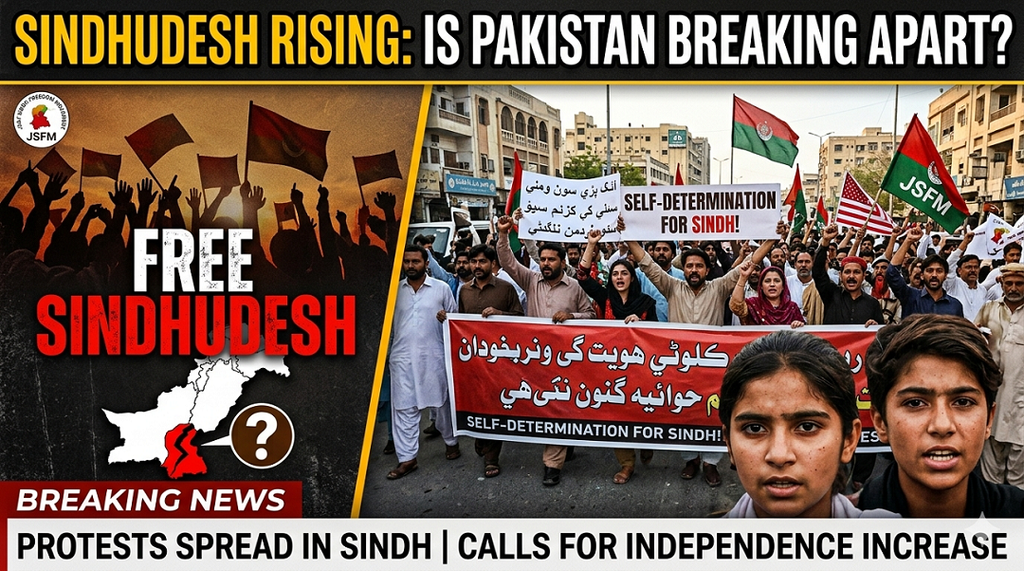
The “Free Sindhudesh” movement is once again drawing attention as Sindhi nationalist groups continue to organize protests and campaign for greater political autonomy and, for some organizations, an independent Sindhudesh.
The renewed attention comes amid wider political and security tensions across Pakistan, including unrest in Balochistan, political movements in Pakistan-administered Kashmir, and growing debates over provincial governance.
Recent activity by the Jeay Sindh Freedom Movement (JSFM) and other Sindhi nationalist organizations has placed the question of Sindh’s political future back into the spotlight. JSFM describes its objective as a non-violent struggle for the right of self-determination for Sindhudesh.
What Is the Free Sindhudesh Movement?
Sindhudesh is the name used by Sindhi nationalist groups advocating the creation of an independent Sindhi state.
The movement has historical roots in Sindhi nationalism and the ideas associated with G.M. Syed, who became one of the most prominent proponents of Sindhi nationalism and the concept of Sindhudesh.
Today, different groups associated with the Sindhudesh cause have different strategies and political positions. Some emphasize peaceful political activism, cultural identity and self-determination, while other organizations have been associated with militant activity.
This distinction is important because Sindhudesh is not a single unified political organization.
Recent Sindhudesh Activity
Recent developments indicate that Sindhudesh activism remains active both inside and outside Pakistan.
The JSFM reported protests in London in late August 2026 concerning enforced disappearances and the treatment of Sindhi, Baloch, Pashtun, Kashmiri and other political activists. The organization has also continued to campaign internationally for what it describes as the right of Sindhis to self-determination.
Sindhi nationalist rallies have also taken place in Sindh in previous months, with participants raising demands concerning political rights, missing persons and Sindhi national identity.
Meanwhile, other Sindhudesh nationalist organizations have continued to call for greater political unity among Sindhi nationalist groups.
Why Is Sindhudesh Becoming a Talking Point Again?
Several long-standing grievances have contributed to the persistence of Sindhi nationalism.
Among the issues frequently raised by Sindhi nationalist activists are:
- Control over water resources
- Land and agricultural policies
- Political representation
- Economic distribution
- Control of natural resources
- Enforced disappearances
- Cultural and linguistic identity
- The relationship between Sindh and Pakistan’s federal government
These grievances have periodically generated demonstrations and political campaigns.
Water politics has been particularly sensitive in Sindh because the province depends heavily on the Indus River system for agriculture, drinking water and economic activity.
Sindh’s Strategic Importance
Any discussion about Pakistan’s territorial integrity inevitably has to consider Sindh’s strategic importance.
Sindh contains Karachi, Pakistan’s largest city and one of its most important economic centers.
The province also contains major ports, industrial infrastructure, agricultural regions and significant energy and natural resources.
For that reason, a hypothetical political separation of Sindh would have enormous economic and geopolitical consequences for Pakistan.
However, there is currently no evidence that Sindh is on the verge of formally separating from Pakistan.
The existence of separatist protests should not automatically be interpreted as evidence of an imminent change in national borders.
Sindh Assembly Debate Adds Another Dimension
The political debate in Sindh has also recently included questions about provincial restructuring.
According to Dawn, the Sindh Assembly began debating the creation of new provinces on September 1, 2026. The discussion included proposals concerning administrative restructuring and Karachi, although Sindh Chief Minister Syed Murad Ali Shah ruled out dividing Sindh.
This is different from the Sindhudesh independence movement.
A proposal for new administrative provinces within Pakistan does not necessarily imply support for an independent Sindhudesh.
Nevertheless, the debate demonstrates how questions about Sindh’s identity, governance and political structure remain highly sensitive.
Balochistan, Kashmir and Sindh: A Broader Pattern?
The renewed discussion about Sindhudesh comes against the background of political and security tensions elsewhere in Pakistan.
Balochistan has experienced a long-running separatist insurgency involving several armed organizations.
Pakistan-administered Kashmir has also witnessed significant political protests over governance, economic pressures and local rights.
Sindh’s nationalist movement therefore receives increased attention whenever multiple regional grievances emerge simultaneously.
Some analysts and political commentators interpret these developments as evidence of increasing pressure on Pakistan’s federal structure.
However, it is important not to treat these movements as one coordinated campaign without evidence.
The political circumstances, organizations and demands in Balochistan, Sindh and Pakistan-administered Kashmir are different.
Is Pakistan Really Facing an “Expiry Date”?
The phrase “Pakistan’s expiry date is getting closer” has appeared in social-media commentary surrounding separatist movements.
It is a powerful political slogan, but it should not be presented as a factual prediction.
Pakistan remains a sovereign state with functioning federal and provincial institutions, a large population, military establishment and substantial economic and geopolitical importance.
At the same time, the persistence of separatist and autonomy movements demonstrates that questions about federalism, regional inequality and political representation remain significant challenges.
Whether these movements grow substantially depends on numerous factors, including economic conditions, political developments, government policy, security responses and the ability of nationalist organizations to build broad popular support.
What Could Increase Sindhudesh Support?
Several developments could potentially increase support for Sindhi nationalism.
Economic grievances
If communities believe that local resources are being exploited without sufficient economic benefits returning to Sindh, nationalist sentiment could become stronger.
Water disputes
Water allocation remains an emotionally and economically important issue for Sindh’s population, particularly farmers.
Political representation
Perceptions of political marginalisation can strengthen regional identity movements.
Human-rights concerns
Allegations involving enforced disappearances and treatment of political activists have been repeatedly highlighted by Sindhi nationalist organisations.
Federal-provincial tensions
Disputes between Islamabad and provincial governments can also reinforce arguments for greater provincial autonomy.
What Could Prevent Separatism From Growing?
At the same time, several factors could limit the growth of an independence movement.
Sindh is deeply integrated into Pakistan’s political, economic and social system. Karachi is a major economic center for the country, while Sindh’s population includes diverse linguistic, ethnic and political communities.
Mainstream political parties also remain influential in the province.
Furthermore, separatist movements need sustained mass political support to transform demonstrations and slogans into a viable independence campaign.
Therefore, visibility on social media should not be confused with nationwide popular support.
The Bigger Question for Pakistan
The significance of the Sindhudesh debate goes beyond separatist slogans.
At its core, it raises a broader question:
Can Pakistan’s federal system adequately address the economic, political and cultural concerns of its provinces?
If provincial grievances are addressed through political representation, economic development and constitutional mechanisms, separatist demands may remain limited.
If grievances intensify and peaceful political avenues are perceived as ineffective, nationalist movements could gain additional momentum.
That makes governance and federal-provincial relations particularly important for Pakistan’s long-term stability.
Conclusion
The renewed visibility of Free Sindhudesh activism shows that Sindhi nationalism remains an important political current in Pakistan.
Recent protests and international campaigning by Sindhi nationalist groups demonstrate that demands for self-determination have not disappeared.
However, it would be premature to conclude that Sindh is approaching independence or that Pakistan is facing an imminent territorial breakup.
The more immediate issue is whether Islamabad and provincial authorities can address longstanding concerns involving governance, resources, political representation and regional identity.
For now, “Free Sindhudesh” remains a political and nationalist demand rather than an imminent change in Pakistan’s borders.
FAQs
What is Sindhudesh?
Sindhudesh is the term used by Sindhi nationalist movements advocating an independent Sindhi homeland or greater self-determination for Sindh.
Are Free Sindhudesh protests currently taking place?
Sindhudesh nationalist organizations continue to organize protests and political campaigns, including recent activities reported by the JSFM.
Does Sindhudesh have popular support across Sindh?
The extent of popular support is difficult to measure. The presence of protests and nationalist organizations does not by itself demonstrate majority support for independence.
Is Sindh likely to separate from Pakistan?
There is currently no reliable evidence establishing that Sindh is on the verge of separating from Pakistan.
Why is Sindh strategically important to Pakistan?
Sindh contains Karachi, major ports, industrial infrastructure, agricultural areas and important economic resources, making it one of Pakistan’s most strategically significant provinces.
Is the Sindhudesh movement the same as the Baloch separatist movement?
No. They are separate movements with different histories, organizations and political objectives, even though both involve questions about regional identity and relations with Pakistan’s federal state.